


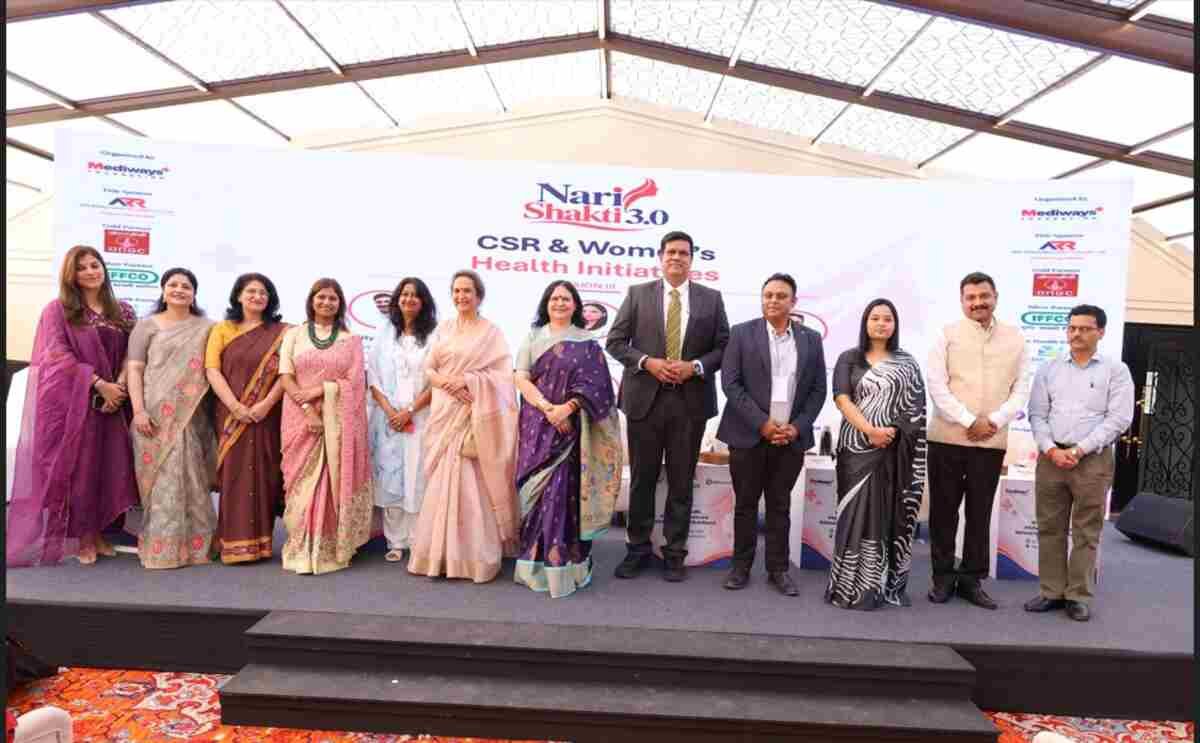
- Theme Identified at Nari Shakti 3.0 is to take care of moving from one time health camps to sustainable health programs for women
A need to transition Corporate Social Responsibility (CSR) activities for women’s health from one time health screening camps to more sustainable health care programs was highlighted at Nari Shakti 3.0 organized by Mediways Health Foundation.
The panel discussion featured professionals from the fields of healthcare, corporate CSR, real estate, social impact and development to deliberate on ways in which CSR activities could improve preventive healthcare for women especially those living in underserved and distant regions.
The panel was composed of Dr Bhavani Nair, AVP – Clinical Operations (North India) and Strategic Projects, Clove Dental; Aditya Mishra, Head – CSR & ESG, Signature Global; Ritesh Sinha, CSR Head, Krishna Maruti; Neha Agarwal, Founder and CEO, LightRoad; and Anushka Bonia, Corporate Social Responsibility Lead, Johnson Matthey India. The discussion was chaired by Roch Ferreira.
Dr Bhavani Nair stated that interventions in the field of healthcare require more than just the organization of screening camps. The emphasis was laid on accessibility and affordability of healthcare services along with the linkage of screening with awareness, consultation, and care. Dr Bhavani Nair also mentioned that factors like fear, lack of information, social stigma, and affordability act as barriers for women in seeking healthcare services.
According to Dr Bhavani Nair, “CSR interventions in the domain of women’s health should go beyond organizing camps or screenings. The real impact happens only when women gain access to affordable healthcare, realize their healthcare needs and take up the prescribed course of treatment. It is also necessary to address issues like fear, lack of information, and social stigma which often act as barriers in women’s seeking healthcare. Therefore, preventive healthcare must revolve around awareness and accessibility.”
The other issue raised by Aditya Mishra was that of making it a continuum of care especially with regard to the disadvantaged groups including construction workers. He pointed out that CSR programs have to include preventive care, diagnosis, and follow-up care instead of just being screening programs.
Aditya Mishra said, “The objective should be to create a continuum from prevention to screening, diagnosis and sustained care. Technology helps us in handling the scale, keeping digital records, identifying risks and doing follow-ups. But technology alone is not the solution to the problem of healthcare delivery.”
According to Ritesh Sinha, there is a need for a project-based and life cycle approach to CSR. While CSR interventions have become more focused towards preventive health care, Ritesh pointed out that there is a requirement for a targeted approach to the neglected areas like mental health, anaemia, malnutrition, and menstrual health in underprivileged communities.
Ritesh Sinha further stated, “A women’s health programme must shift from being an event-based intervention to a long-term, project-based intervention. An effective programme must be based on need assessments and baselines, screening and treatments, followed by follow-ups and behavioural change interventions. Health seeking behavior building is a better measure of success than counting beneficiary numbers.”
Neha Agarwal talked about the possibility of using innovative and blended financing to make social interventions more sustainable and scalable. She said, “It is possible to use CSR capital to catalyse additional private/public capital into health care programs through the use of innovative financing and outcomes.”
As Neha Agarwal said, “When CSR capital is used along with innovative financing and outcomes, it can act as a catalyst. The key focus, especially for underserved regions, should be not just about the number of women who have been screened, but on how many of them have actually used the health care facilities and completed the follow-up.”
Anushka Bonia talked about how crucial it is to target women in those communities which continue to lag behind geographically and
