


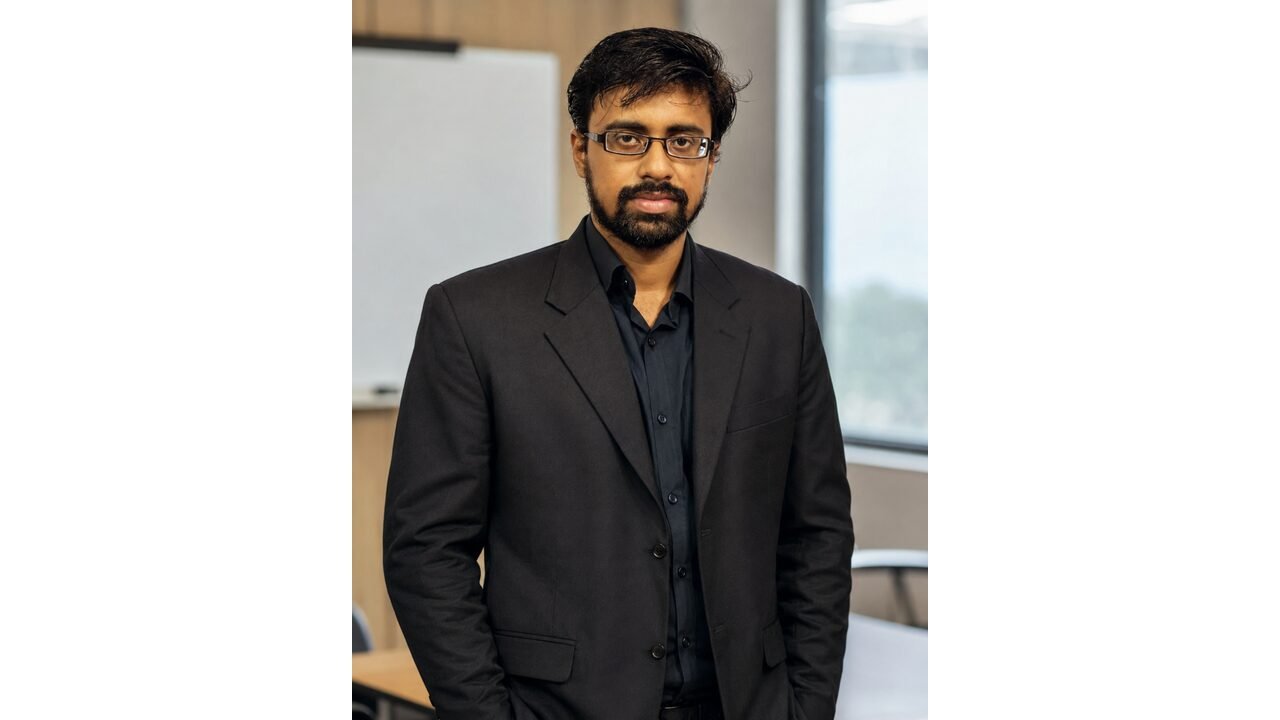
There are journeys that begin with carefully prepared business plans, large investments and ambitious projections, and then there are journeys that begin with something much simpler—a teacher sitting in front of a student and trying to make a difficult concept understandable. The story of Dr. Sourav Sir’s Classes belongs largely to the second category. What gradually developed into a growing educational platform began with a fundamental belief that education should never become merely a mechanical exchange of notes, lectures and examinations. At its best, education must give a student clarity, confidence, direction and the ability to think independently.
For Dr. Sourav Sir, teaching was never meant to be restricted to completing chapters from a syllabus. The larger purpose was always to understand what prevented a student from progressing. Sometimes the difficulty was conceptual. Sometimes it was a lack of proper planning. Some students possessed sufficient knowledge but were unable to reproduce it effectively in an examination. Others were academically capable but confused about courses, universities, entrance examinations or future careers. Recognising these different problems gradually shaped an approach to education in which teaching, mentoring, examination preparation and career guidance could exist together.
This philosophy eventually became one of the foundations of Dr. Sourav Sir’s Classes.
The modern student lives in an unusual educational environment. Information has never been more accessible. A student can find books, lectures, notes, question papers, educational applications and countless videos within seconds. Yet greater access to information has not necessarily eliminated confusion. In many cases, it has created another problem: students possess enormous quantities of material but do not know what to prioritise. They may study for several hours without knowing whether their preparation is actually moving in the right direction.
Dr. Sourav Sir recognised that the real value of a teacher in this changing environment lies not simply in supplying information. A teacher must help students organise information, understand concepts, identify weaknesses, develop strategies and make better decisions. Teaching therefore needs to become more personal rather than less personal, even when technology allows education to reach much larger numbers of learners.
This thinking influenced the development of Dr. Sourav Sir’s Classes from its early stages. Instead of treating every student as though they possessed identical strengths, weaknesses and learning speeds, greater emphasis was placed on understanding individual academic requirements. One student might require intensive conceptual clarification; another might need regular problem-solving practice. Someone preparing for a competitive examination could require previous-year-question analysis and mock tests, while a university student might require detailed support with an advanced subject that is rarely explained adequately through conventional resources.
Such differences may appear small from the outside, but they can completely change the outcome of a student’s preparation.
This is why mentorship became important.
A student does not always need another textbook. Sometimes what that student needs is someone who can say, “This is where you are making the mistake. This is what you should concentrate on now. This portion can wait. This concept needs to be strengthened before you move forward.”
That kind of guidance transforms teaching from a one-directional lecture into a continuing academic relationship.
As the number and variety of learners increased, the educational vision also expanded. Dr. Sourav Sir’s Classes gradually developed academic support across different levels—from university courses and specialised subjects to competitive examinations and entrance preparation. The objective was not to restrict learning within a narrow category but to build a platform capable of responding to students whose academic journeys may be entirely different from one another.
This presented another challenge. Academic excellence cannot depend entirely upon one individual. If an institution wishes to teach a wide variety of subjects effectively, it requires qualified teachers, carefully selected mentors, appropriate learning resources and a system capable of maintaining quality while expanding.
The development of a wider faculty network therefore became an important part of the journey.
For Dr. Sourav Sir, building an educational institution meant gradually bringing together teachers and academic professionals who could contribute expertise in different areas. The aim was to create an ecosystem in which students could receive specialised guidance without losing the personal character of mentoring that had shaped the institution from the beginning.
At the same time, the rapid transformation of digital education created possibilities that earlier generations of teachers could scarcely have imagined.
A student no longer needs to live in the same neighbourhood—or even the same city—as the teacher. Online classes can connect learners and educators across geographical boundaries. Recorded sessions can allow students to revisit difficult concepts. Digital materials can make revision more systematic. Online doubt-solving can provide support when traditional classroom access is impossible.
Yet technology alone does not constitute education.
One of the important principles behind the evolution of Dr. Sourav Sir’s Classes has therefore been that technology should support the teacher-student relationship rather than replace it. A recorded lecture may explain a theorem, but it cannot always identify why one particular student repeatedly misunderstands the theorem. An automated test may reveal a low score, but a mentor can help determine whether the problem arose from weak fundamentals, poor time management, examination anxiety or an incorrect preparation strategy.
The most effective model of modern education may therefore lie somewhere between the traditional classroom and the purely digital platform.
Dr. Sourav Sir’s Classes has attempted to work within that space—combining online and offline learning, personal mentorship, recorded academic support, mock examinations, previous-question practice, doubt solving and structured preparation according to the requirements of different learners.
But the story is not only about examinations.
Examinations are undeniably important. They determine admission opportunities, academic progression and, in many cases, career options. Students naturally want good marks, competitive ranks and successful results. However, reducing education entirely to scores can create another form of weakness. A student might memorise hundreds of answers and still lack the confidence to solve an unfamiliar problem.
For this reason, conceptual understanding has remained a central emphasis.
When a student understands why a method works, knowledge becomes transferable. The same learner can approach an unfamiliar question with greater confidence because the underlying principle is clear. This becomes especially important in mathematics, statistics, science, economics, competitive examinations and other analytical disciplines where questions may deliberately appear different while testing the same fundamental idea.
Teaching such subjects effectively requires patience.
A difficult concept may need to be explained in several ways. A student may require examples before abstraction. Another may understand the theory but need extensive practice before gaining confidence. There cannot always be one universal method.
This flexibility is also part of Dr. Sourav Sir’s teaching philosophy: the responsibility of understanding should not rest only on the student; the teacher must continuously search for better ways of explaining.
Over time, another dimension became increasingly important—career guidance.
Students today face an extraordinary number of educational possibilities. Traditional university degrees exist alongside interdisciplinary programmes, professional courses, national entrance examinations, research careers, international opportunities and rapidly emerging fields. The problem is no longer simply choosing between two or three conventional professions.
A student may ask whether to pursue mathematics or statistics, economics or data science, research or industry, a government institution or an expensive private programme. Another student may be considering whether taking an educational loan is worthwhile. Someone else may be deciding whether to attempt an entrance examination again or accept the admission currently available.
These decisions can influence several years of a young person’s life.
Consequently, Dr. Sourav Sir’s approach to education gradually moved beyond subject teaching toward helping students evaluate opportunities more carefully. The objective is not to make every decision on behalf of the learner but to provide enough information and perspective for the student to make an informed decision.
This represents an important distinction.
True mentorship does not create dependency. It gradually creates independence.
A successful teacher should eventually make a student capable of thinking without constant assistance.
The growth of Dr. Sourav Sir’s Classes has also taken place during a period when educational entrepreneurship itself is changing. Conventional coaching centres once depended heavily upon physical classrooms and local reputation. Today, an educational institution must communicate with students across websites, video platforms, social media, online classrooms and digital learning systems.
For Dr. Sourav Sir, this digital expansion has not simply been about marketing. Educational content distributed through online platforms can itself become a form of public guidance. A short discussion about choosing a college, avoiding an expensive mistake, understanding an examination, recognising misleading career promises or approaching a difficult academic problem can reach students who may never enrol in a formal course.
This broader educational communication has become another extension of the original classroom.
The classroom has, in a sense, become larger.
A teacher who once spoke to a small group can now potentially communicate with thousands of learners. But with greater reach comes greater responsibility. Educational advice needs to remain practical, understandable and grounded in students’ actual circumstances. Popularity cannot replace accuracy, and visibility cannot replace substance.
The long-term ambition behind Dr. Sourav Sir’s Classes is therefore not simply to become larger. Growth without quality would contradict the very philosophy upon which the institution was built.
The more meaningful ambition is to create an educational ecosystem in which a student can find knowledge, mentorship, examination preparation, academic resources and career direction under a structured system, while still feeling that the individual learner matters.
There have naturally been challenges along the way.
Building an educational institution means dealing with changing examination patterns, diverse student expectations, technological transitions, faculty coordination, academic quality and the constant need to improve learning resources. What works for one batch may need modification for another. A course that succeeds in an offline environment may require a completely different structure when delivered online.
Every stage therefore requires adaptation.
And perhaps that is one of the most important lessons from the journey itself: education can never become static.
Teachers must continue learning.
Institutions must continue evolving.
Technology must be adopted intelligently.
Students must continue questioning.
And academic systems must remain flexible enough to respond to a world in which knowledge and careers are changing at unprecedented speed.
For Dr. Sourav Sir, the journey of building Dr. Sourav Sir’s Classes is consequently far from complete. Each new student brings another problem to understand, another ambition to support and another opportunity to improve the educational system being created.
There may be milestones along the way—growing numbers of learners, an expanding faculty, new courses, digital initiatives, successful students and greater visibility—but the fundamental measure of success remains much more personal.
Did a confused student find clarity?
Did someone who feared a subject finally understand it?
Did an aspirant learn how to prepare more intelligently?
Did a student avoid making an unnecessary academic or financial mistake?
Did someone discover an opportunity they previously did not know existed?
And, most importantly, did education make that person more capable of determining their own future?
Those questions return the journey to where it originally began: the relationship between a teacher and a student.
Institutions can acquire infrastructure. Platforms can acquire technology. Courses can acquire sophisticated materials. But the heart of education still lies in the moment when something that once appeared impossible finally becomes understandable.
That moment has always been the teacher’s greatest reward.
The story of Dr. Sourav Sir’s Classes is therefore not simply the story of creating another coaching platform. It is a continuing attempt to redefine what academic support can mean in an age where students have unlimited information but still require reliable guidance.
What began with teaching has gradually evolved into mentoring, institution-building, digital education and a larger educational mission. Yet the underlying purpose remains remarkably unchanged:
to make quality education more understandable, accessible, personal and meaningful for every student who seeks guidance.
And as Dr. Sourav Sir’s Classes continues to grow, perhaps its most important achievement will not ultimately be measured by the size of the institution, the number of programmes offered or the reach of its digital presence.
It will be measured by the journeys of the students who once entered with questions—and eventually left with the confidence to find their own answers.
For more details : https://www.souravsirclasses.com/
