


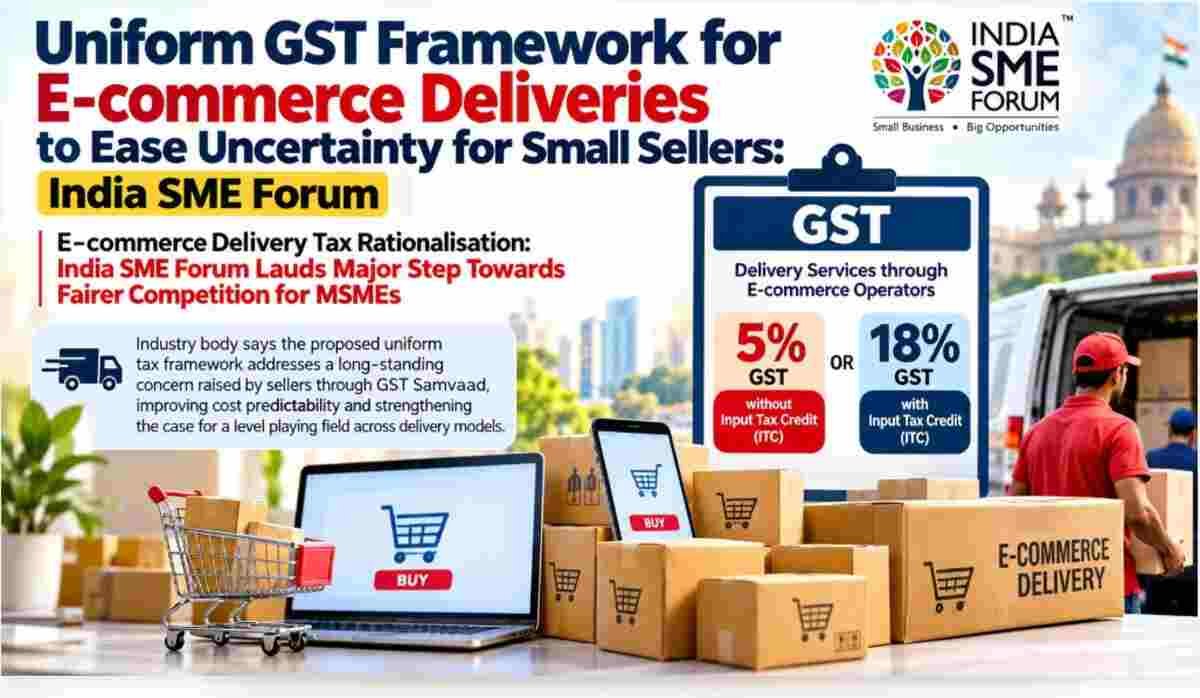
E-commerce Delivery Tax Rationalisation: India SME Forum Lauds Major Step Towards Fairer Competition for MSMEs
Industry body says the proposed uniform tax framework addresses a long-standing concern raised by sellers through GST Samvaad, improving cost predictability and strengthening the case for a level playing field across delivery models
NEW DELHI, 14th October 2026: India SME Forum (ISF) has welcomed the GST Council’s recommendation to rationalise the taxation of delivery services supplied through Electronic Commerce Operators (ECOs), calling it an important step towards resolving a long-standing concern raised by India’s small businesses and e-commerce sellers. Under the proposed framework, delivery services supplied through e-commerce operators will attract GST at 5% without input tax credit (ITC), or 18% with ITC. The move seeks to establish a more uniform tax treatment for such services, addressing disparities that have emerged across different business and logistics models.
For small and medium enterprises selling through digital marketplaces, logistics is not merely an operational expense but a critical determinant of competitiveness. Differences in tax treatment across delivery models have contributed to uncertainty over costs and created concerns about whether businesses operating in the same sector are competing on a level playing field. The Council’s recommendation addresses this structural issue by establishing a clearer and more uniform tax framework.
The proposed change addresses a broader structural concern in India’s rapidly evolving digital commerce ecosystem. E-commerce marketplaces, independent sellers, logistics providers and last-mile delivery networks are closely interconnected. Greater consistency in the tax treatment of comparable services can help reduce distortions between competing delivery models and provide businesses with a clearer and fairer basis for long-term operational decisions.
“For India’s small businesses, the cost of getting a product to the customer is just as important as the cost of making it. For the past year and half, our sellers have repeatedly raised concerns about the uncertainty and disparity in the GST treatment of e-commerce delivery services during our GST Samvaad engagements across cities. When businesses providing comparable services face different tax treatment depending on how their operations are structured, it creates an uneven playing field and makes long-term planning difficult. The GST Council’s recommendation is an important step towards addressing this concern. A more uniform and predictable framework will help sellers make better-informed decisions on logistics, pricing and expansion, while strengthening the competitiveness of MSMEs selling through e-commerce,” said Vinod Kumar, President, India SME Forum.
The timing of the recommendation is particularly significant ahead of the festive season, one of the busiest periods for India’s e-commerce ecosystem. Millions of small businesses depend on online marketplaces to reach customers across states and beyond their traditional markets. For these sellers, a simpler and predictable logistics framework is essential to planning inventory, managing margins and meeting increased consumer demand during peak sales periods.
India SME Forum said the recommendation should be viewed alongside the GST Council’s broader efforts to simplify compliance and improve the ease of doing business for MSMEs. Measures such as relief through refunds of accumulated input tax credit under the inverted duty structure, simplified GST registration processes, and easing requirements around the principal place of business, among others represent important steps towards reducing compliance burdens, improving working capital availability and enabling small businesses to scale and participate more effectively in India’s growing digital economy.
India SME Forum said it will continue to engage with policymakers to ensure that these recommendations translate into practical, accessible benefits for MSMEs, with clear implementation guidelines and simpler processes that help small businesses scale, compete and participate more effectively in India’s growing digital economy.
