


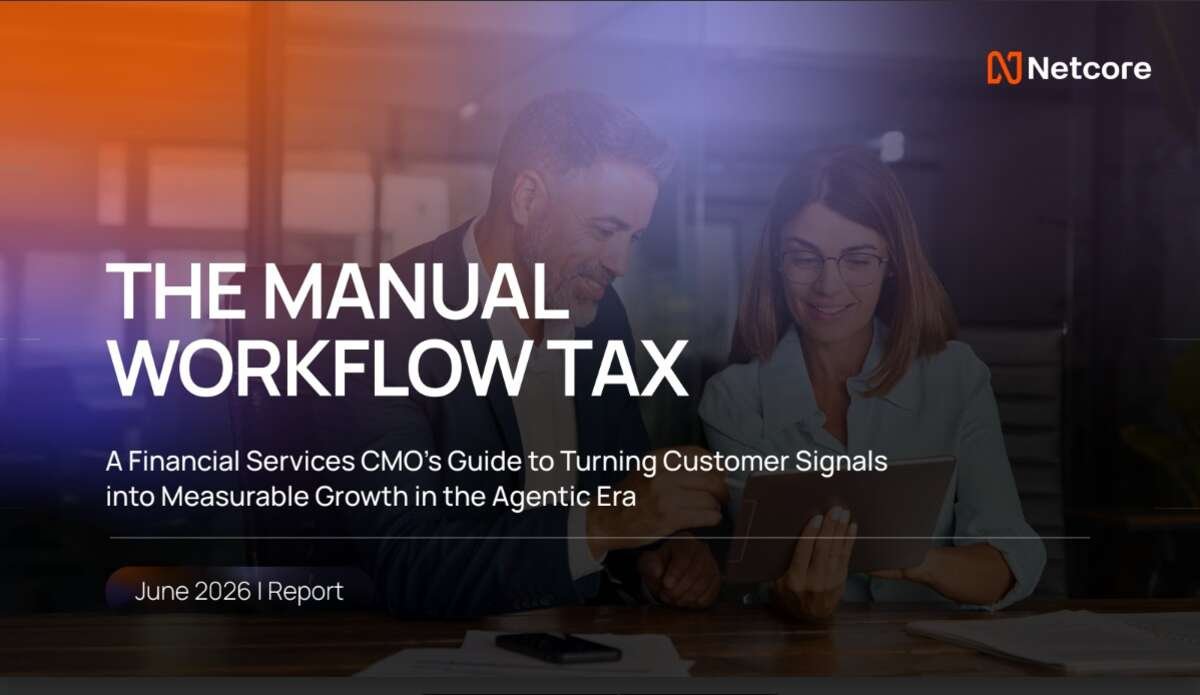
The revenue lost to slow campaigns never shows on a report. It simply never appears. “The Manual Workflow Tax” maps what banking and financial services brands are losing and what closes the gap.
Mumbai, India, 1st July – Netcore today released The Manual Workflow Tax, a guide for chief marketing officers in banking, financial services, and insurance across India and Southeast Asia. The report argues that the manual, batch-and-broadcast campaign model most BFSI brands still run is no longer a workflow inefficiency. It is a measurable, compounding cost on revenue and customer trust.
The report introduces the manual workflow tax: the revenue that quietly disappears when campaign cycles take days to build, while customer intent windows close in hours. A salary credit, a loan approval, and a policy, twelve days from renewal, each open a short moment where a relevant message converts and one just after where it does not. Manual cycles miss those windows structurally, and the lost revenue never shows up on a report. It simply never appears.
The cost is twofold. There is speed loss from missed intent windows, and trust loss from irrelevant messaging. The report cites that 43% of users disable BFSI notifications entirely when messages feel excessive or irrelevant (Latinia, 2025), while segmented BFSI messaging delivers 59 percent higher click-through rates than broadcast (WFIS, 2024). For a brand running 10 million customer journeys a year, even a one percent improvement in intent-window conversion translates into tens of millions in incremental revenue.
“Financial services brands that win the next decade will reach the right customer at the exact moment their financial life creates an opening. Miss it, and you pay to reacquire someone you already had. AI that reads behavioural signals in real time and agents that act within defined goals and guardrails make that possible at scale – for the first time. The brands that build it first will be very hard to displace. “ Rajesh Jain, Founder & MD, Netcore.
The context raises the stakes. India now accounts for 49% of the world’s real-time payment transactions, and Southeast Asia’s mobile fintech penetration has tripled since 2019. Customers reset their expectations inside non-bank super-apps, and they bring those expectations to every financial brand they touch. Against that backdrop, the report makes the case for agentic AI as the operating layer for BFSI marketing rather than a contained pilot. EY projects that 60% of brands will use agentic AI for one-to-one interactions by 2028. The report’s position is that this works only when brand governance and compliance are built into the AI, so speed never comes at the cost of trust.
The guide is built to be run, not just read. It gives marketing leaders a model for mapping high-value customer moments across retail banking, insurance, and wealth management, a framework for converting compliance under DPDP and PDPA from a cost centre into a trust asset, and a redefinition of the BFSI CMO as both brand builder and intelligence architect.
This Industry Contributor Edition features perspectives from senior BFSI marketing and growth leaders on what changes when teams act on customer moments in real time.
“Customer centricity in the AI era is not about selling more products. It is about recommending the right investment at the right moment. If AI tells us a first-time investor needs a low-risk hybrid fund instead of an equity NFO, choosing relevance over revenue is true customer centricity,” Ranabir Bose, Head of Marketing, Aditya Birla Capital (Mutual Funds).
“Customer intent is one of the most valuable assets in the NBFC industry, but it’s also one of the most time-sensitive. Agentic AI is enabling organisations to recognise customer intent, personalise engagement, and respond in real time, transforming customer moments into long-term relationships,” said Suresh Arumugam, Deputy General Manager of Growth Marketing & Cross Sell, Shriram Finance Limited
Availability. The Manual Workflow Tax is available to BFSI marketing leaders across India and Southeast Asia. [Insert download or request link.] Netcore’s BFSI engagement team works with marketing leaders in the region to run the operating-model audit the report outlines.
Read the report – LINK
About Netcore
Netcore Cloud is a leading agentic marketing platform that helps brands create personalised, omnichannel customer experiences at scale. Powered by AI, Netcore’s Customer Engagement Suite enables businesses to unify customer data, activate intelligent segments, and orchestrate meaningful interactions across the customer lifecycle. Trusted by over 6,500 brands globally across Ecommerce, Retail, Banking and Financial Services, Media and Entertainment, and Travel, Netcore Cloud works with leading enterprises including Walmart, Unilever, Tommy Hilfiger, Domino’s, McDonald’s, Pizza Hut, and Crocs. Netcore Cloud is appraised at Level 3 of ISACA’s CMMI® by Equalitas Certifications Limited, underscoring its commitment to process excellence. For more information, visit netcorecloud.com.
